
Metal Roofing in St Petersburg, FL: What to Look For
Sep 07, 2026Metal roofing can be a strong fit for St. Petersburg homes, but choosing the right metal roof here takes more than picking a color and panel style. Salt exposure, Florida sun, wind uplift, heavy rain, roof geometry, fastening methods, and the exact roofing system all affect how well that roof will perform. At Roofing.co, we serve homeowners in St. Petersburg and throughout Central Florida, so our goal is to help homeowners understand those differences before choosing a system. We believe the better question isn’t simply, “Is metal roofing good?” It’s, “Which metal roofing system makes sense for this particular home and location?”
Key Takeaways
- For homes near salt or brackish water, corrosion resistance should be one of the first considerations when choosing a metal roofing system.
- Standing seam roofing uses concealed attachment systems and can accommodate thermal movement better than many exposed-fastener configurations.
- A thicker panel does not automatically make a roof suitable for every St. Petersburg home; the complete tested assembly, fastening pattern, substrate, and design pressures matter.
- Florida Product Approval and manufacturer installation requirements are more useful than relying on a generic “mph rating.”
- Underlayment, clips, fasteners, flashing, penetrations, and metal compatibility can affect the roof just as much as the visible panels.
- Homeowners should compare warranties carefully because coastal exclusions and saltwater setbacks can differ significantly between manufacturers.
1. Start With Your Home’s Distance From Salt Water
Metal roofing in St Petersburg FL — being a large city, specific location will materially affect which metal should be a consideration.
The scenario changes for a home further inland than one that sits on Tampa Bay, Boca Ciega Bay, a canal or other salt- or brackish-waterway property. Chlorides in the air can also cause corrosion, especially if moisture is present at the same time.
That doesn’t mean every home in St. Petersburg within a certain distance of the water automatically needs aluminum, of course. The more appropriate method is to review the restrictions and warranties connected with the real roofing system product under consideration.
Certain metal roofing warranties exclude installations within about 1,500 feet of salt or brackish water. Other more recent coated steel systems boast considerably reduced coastal setbacks, while aluminum systems may be certified by their producers for installation far closer to the shoreline.
When Does Aluminum Make More Sense?
Aluminum deserves serious consideration on properties with high salt exposure because aluminum contains no iron and therefore does not rust in the same way carbon steel does.
That does not make aluminum immune to every form of corrosion or installation problem. The coating, flashing, clips, fasteners, drainage conditions, and contact with other metals still matter.
For a waterfront property, we would want to know more than the ZIP code. We would look at the home’s actual exposure and then compare that against the manufacturer’s published coastal warranty and installation requirements.
For steel roofing, the same principle applies. Some modern zinc-aluminum-magnesium steel systems are specifically marketed and warrantied for coastal conditions that would fall outside the warranty limits of conventional products.
The practical takeaway: Don’t buy a metal roof based solely on “aluminum versus steel.” Ask whether the exact material, coating, and system is warranted for your property’s distance from salt or brackish water.
2. Look Closely at Standing Seam vs. Exposed-Fastener Roofing
For many residential applications, standing seam metal roofing is worth considering because its primary fasteners are concealed beneath the panels rather than driven through the exposed roof surface.
A clip-attached standing seam system can also be designed to allow the panels to move as temperatures change. That matters in Florida, where metal roof surfaces experience significant heating and cooling throughout the day.
The Metal Construction Association notes that standing seam clips and fastening methods need to accommodate thermal expansion and contraction while still meeting the required structural loads. Clip selection should therefore match the specific panel system and engineering requirements.
That is one reason homeowners should be cautious about judging a metal roof only by appearance.
Two roofs may both look like standing seam systems from the ground but use different:
- Panel widths and seam heights
- Clip systems
- Seam-locking methods
- Fastening patterns
- Panel materials and thicknesses
- Florida Product Approvals
Those differences can change how the finished roof performs.
Are Mechanically Seamed Panels Better Than Snap-Lock Panels?
Neither seam style should be chosen based on the name alone.
Snap-lock standing seam panels join together without field-seaming the full joint, while mechanically seamed systems use equipment to fold or lock the seams after the panels are installed. Mechanically seamed systems can provide additional weathertightness and are often used where wind exposure, roof slope, or project specifications call for them.
The right choice depends on the roof design and tested system requirements rather than a universal rule that one style is always better.
3. Check the Florida Product Approval, Not Just a Wind-Speed Claim
You may see metal roofs promoted with claims such as “160-mph,” “180-mph,” or even higher wind resistance. Those numbers can sound reassuring, but they do not tell you enough on their own.
Florida evaluates roofing products as complete assemblies. A particular metal panel may have a Florida Product Approval containing limits for its substrate, attachment method, design pressure, panel configuration, fastener spacing, and where it can be used. The state’s current product-approval database is based on the 2023 Florida Building Code.
Wind performance also depends on the building itself.
Roof shape, roof height, building exposure, location on the roof, deck construction, panel width, fastening pattern, and other engineering variables influence the pressures a roof must resist.
For that reason, we’d rather see homeowners ask:
“What Florida Product Approval applies to this roof system, and is this installation consistent with it?”
That question tells you considerably more than an isolated marketing claim about miles per hour.
4. Understand Metal Gauge Before Assuming Thicker Is Always Better
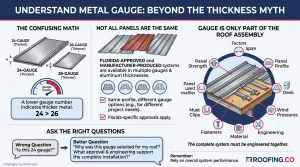
If you’re comparing steel roofs, you may hear contractors discuss 24-gauge and 26-gauge panels.
The numbering can be confusing: a lower steel gauge number generally indicates thicker metal, so 24-gauge steel is thicker than 26-gauge steel.
But this is another area where one specification should not become the entire buying decision.
For example, Florida-approved and manufacturer-produced standing seam systems are available in multiple steel gauges as well as aluminum thicknesses. Some manufacturers offer the same panel profile in both 24- and 26-gauge steel, depending on the project.
A thicker panel may offer advantages for certain applications, but panel strength is only part of the roof assembly. Span, panel profile, clips, deck, fasteners, wind pressures, material, and engineering all matter.
So instead of asking only, “Is this 24 gauge?” ask why that gauge was selected for your roof and what approval or engineering supports the complete installation.
PROTECT YOUR ROOF TODAY
In a hurry? Call us at 727-309-3344
5. Pay Attention to the Finish, Especially Under Florida Sun
The finish that protects selected painted metal roofing ranks hardly behind the wood casing below it.
Commonly found with premium metal roofing systems are polyvinylidene fluoride, or PVDF, coatings. Factory applied finishes are utilized because of their weathering, fading and chalk resistance.
This can come in handy here in St. Petersburg where a roof is under strong UV radiation for some parts of the year.
Because “PVDF” by itself is not sufficient of a signal.
For properties near saltwater, verify that the specific finish offers a coastal warranty and if it varies by distance from the shoreline. Manufacturers may provide stand-alone standard and marine-grade coating systems, each with its limited range.
Request to see the warranty in writing instead of receiving a verbal commitment on how long the paint should last.
6. Don’t Overlook the Underlayment
The metal panels are what you see, but they are only one layer of the roofing system.
Underneath them is the roof deck and underlayment. The underlayment provides another line of water protection and must be suitable for the roofing assembly and installation.
The right specification can vary depending on roof slope, panel system, deck, manufacturer requirements, and code requirements.
Homeowners sometimes hear recommendations for a particular brand of self-adhered underlayment and assume that product is automatically the best option. We wouldn’t make that decision from a brand name alone.
The more important questions are whether the underlayment is approved for the assembly, compatible with the metal roof, installed according to its specifications, and appropriate for the home’s conditions.
7. Make Sure the Fasteners, Clips, and Flashings Are Compatible
One small component can create a large problem if the wrong metals are combined.
Galvanic corrosion can occur when incompatible metals are electrically connected in the presence of moisture. Salt contamination can make that environment even more aggressive.
The Metal Construction Association specifically advises paying attention to compatibility between roofing metals and fasteners because dissimilar-metal corrosion can shorten the life of an installation.
That means a metal-roof estimate should account for much more than panels.
The contractor should also be considering clips, screws, flashings, pipe penetrations, valleys, gutters, attached accessories, and any other metals that will interact with the roof.
This becomes even more important on coastal St. Petersburg properties.
8. Look at the Entire Roof Design, Not Just the Panels
A good metal panel cannot compensate for poor roof details.
Leaks and premature failures frequently develop around areas where the roofing system changes direction or meets another building component. Chimneys, walls, valleys, skylights, plumbing vents, roof-to-wall transitions, edges, and other penetrations all need properly designed details.
Roof geometry also changes the installation.
A simple gable roof has different detailing requirements from a home with multiple valleys, dormers, additions, low-slope sections, or transitions between roofing materials.
This is one of the areas where two metal roofing quotes can differ considerably. A lower estimate may not necessarily specify the same panel, flashing details, underlayment, edge metal, attachment system, or preparation work.
Compare scope, not just price.
9. Ask What Happens to the Existing Roof and Roof Deck
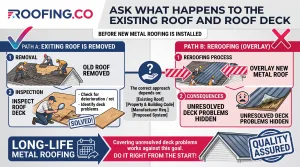
Before new metal roofing goes down, the condition of the structure beneath it matters.
If the existing roof is removed, the roof deck can be inspected for deterioration and other problems that need to be addressed before the new system is installed.
The correct approach depends on the property, existing roof, applicable code provisions, manufacturer requirements, and proposed system.
A metal roof is expected to stay in service for a long time. Covering unresolved deck problems beneath a long-life roofing material works against that goal.
PROTECT YOUR ROOF TODAY
In a hurry? Call us at 727-309-3344
10. Read the Warranty Before Choosing the Roof
“Warrantied for 40 years” does not necessarily mean every part of a roof is covered for 40 years under every condition.
Metal roofing can involve several different warranties, including coverage connected to the metal substrate, paint finish, and contractor workmanship.
Pay particular attention to exclusions involving:
saltwater distance, corrosion, cut edges, improper fasteners, incompatible materials, cleaning requirements, standing water, coastal exposure, and installation outside the manufacturer’s specifications.
Some products marketed for Florida’s coast have very different setback requirements from conventional metal roofing systems.
Ask for those documents before making a final decision.
11. Plan for Maintenance Even With a Metal Roof
Metal roofing is generally considered a relatively low-maintenance roofing option, but “low maintenance” does not mean “never look at it again.”
St. Petersburg’s trees, humidity, storms, salt exposure, and year-round growing conditions can leave debris and organic material around roof valleys, gutters, transitions, and shaded sections.
Keeping debris from accumulating can help water drain properly and gives you a chance to spot developing problems.
Periodic roof inspections are also useful after severe weather, especially around penetrations, flashings, edges, and attached equipment.
Homeowners should avoid casually walking on a metal roof to perform this maintenance themselves. Metal can be slippery, and improper foot placement can damage some panel systems. Ground-level observations and professional inspections are safer when roof access is required.
What Should You Ask a Metal Roofing Contractor in St. Petersburg?
Before signing a proposal, ask enough questions to understand exactly what you’re buying.
Useful questions include what panel material is being proposed, whether the product has coastal restrictions for your address, which Florida Product Approval applies, what underlayment and attachment system will be used, and what the manufacturer requires for your home’s exposure.
You should also know whether the quote includes deck repairs if needed, how valleys and penetrations will be flashed, what warranties apply, and who is responsible for permits and inspections.
The contractor should be able to explain these choices in plain language.
If the answer to every technical question is simply “this is the best system,” you still don’t have enough information to compare your options.
Why Local Conditions Matter for Metal Roofing in St. Petersburg
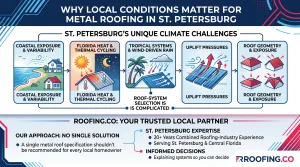
St. Petersburg combines several conditions that make roof-system selection more complicated than it may be elsewhere.
There is substantial coastal exposure across the area, but that exposure is not uniform. A waterfront house may need a different material specification from a property several miles inland. Florida heat creates significant thermal cycling. Tropical systems and thunderstorms introduce wind-driven rain and uplift pressures. Roof geometry and exposure can further change the demands on the assembly.
That’s why we don’t believe a single metal roof specification should automatically be recommended for every local homeowner.
At Roofing.co, our team has more than 20 years of combined roofing-industry experience, and we serve homeowners in St. Petersburg and across Central Florida. Our approach emphasizes explaining roofing systems and materials so homeowners can make informed decisions about their properties.
PROTECT YOUR ROOF TODAY
In a hurry? Call us at 727-309-3344
Metal Roofing in St Petersburg, FL Starts With the Right System
A metal roof can be a long-term roofing option for a St. Petersburg home, but its performance depends on more than the fact that it’s made of metal.
Start with the property’s location. Then look at the substrate, finish, panel profile, attachment method, Florida Product Approval, underlayment, flashing details, fastener compatibility, warranty, and installer.
Those details matter even more near the coast.
If you’re considering metal roofing in St Petersburg FL, we can inspect your existing roof, discuss the available roofing systems, and explain which factors should guide your decision. Roofing.co is based in St. Petersburg and serves homeowners throughout Central Florida.
Request a roofing estimate from Roofing.co to compare metal roofing options for your St. Petersburg home and understand what the installation would require.
Frequently Asked Questions About Metal Roofing in St. Petersburg
Q: Is aluminum better than steel for a metal roof in St. Petersburg?
A: Aluminum can be particularly useful for homes with significant saltwater exposure because it does not contain iron and therefore does not rust like conventional steel. However, some modern coated steel roofing systems are also specifically designed and warrantied for coastal environments. The best choice depends on your property’s exposure and the exact manufacturer’s warranty.
Q: Is 24-gauge metal roofing better than 26-gauge?
A: Twenty-four-gauge steel is thicker than 26-gauge steel, but thickness alone does not determine whether a roof is appropriate for a home. The panel profile, attachment method, deck, fastener spacing, design pressures, Florida Product Approval, and roof geometry also affect performance.
Q: Is standing seam metal roofing a good choice for Florida?
A: Standing seam roofing can be well suited to Florida because concealed clip systems can accommodate thermal movement while keeping primary fasteners beneath the roof surface. The exact system still needs to meet the project’s structural, weather, and installation requirements.
Q: How do I know whether a metal roof meets Florida wind requirements?
A: Ask for the Florida Product Approval or other applicable approval documentation for the exact roofing system. The approval can specify limitations and installation requirements such as attachment details and design pressures. Matching the product to the home’s required wind loads is more meaningful than relying on a standalone advertised mph rating.
Q: Does salt air damage metal roofing?
A: Salt exposure can accelerate corrosion, particularly when moisture and susceptible metals are involved. How much risk exists depends on the metal, protective coating, distance from saltwater, roof details, and manufacturer requirements. Coastal homeowners should specifically review saltwater exclusions in the product warranty.
Q: Does a metal roof require maintenance in St. Petersburg?
A: Yes. Metal roofs are relatively low maintenance, but debris should not be allowed to accumulate in drainage areas, and the roof should be periodically checked for issues around seams, flashing, penetrations, edges, and attached components. Coastal homes may warrant additional attention because of salt exposure.
Services We Offer
Roofing co. can install any roof with great pride and care, no matter what style or type you prefer.
- Cost-Effective Roof Installation
- Roof Inspection
- HVAC Services
- Spray Foam Insulation
Roofing Co roofing system:
- Asphalt Shingle Roofs
- Metal Roofs
- Flat Roofs
At Roofing co. we understand that roofing services can be a significant investment, which is why we offer competitive pricing and financing options to help make our services more accessible to our customers. Contact us today!
